Beachcombing
Plastic Waste: CIC Exhibit
Plastic Waste and the Great Pacific Garbage Patch
CIC Museum Research Document (Created 2/26/2026)
Imagine being a student in Japan, happily retrieving a bottle of your favorite green tea from a vending machine at lunchtime. Laughing and chatting with friends, you toss the empty bottle toward a nearby trash can. It misses and you shrug, assuming someone will pick it up later.
Within minutes, the bottle is gone from your mind. Rain begins to fall, and you hurry back inside for class. Outside, a thin stream of rainwater gathers along the pavement, quietly nudging the bottle into motion. The current strengthens, guiding it toward a storm drain. From there it slips into a river, and eventually it is carried downstream and unceremoniously spat into the Pacific Ocean. This plastic bottle is not alone, roughly 33 billion pounds of plastic enter Earth’s ocean each year, the equivalent of two garbage trucks full of plastic each minute .
Riding the Currents to the Great Pacific Garbage Patch
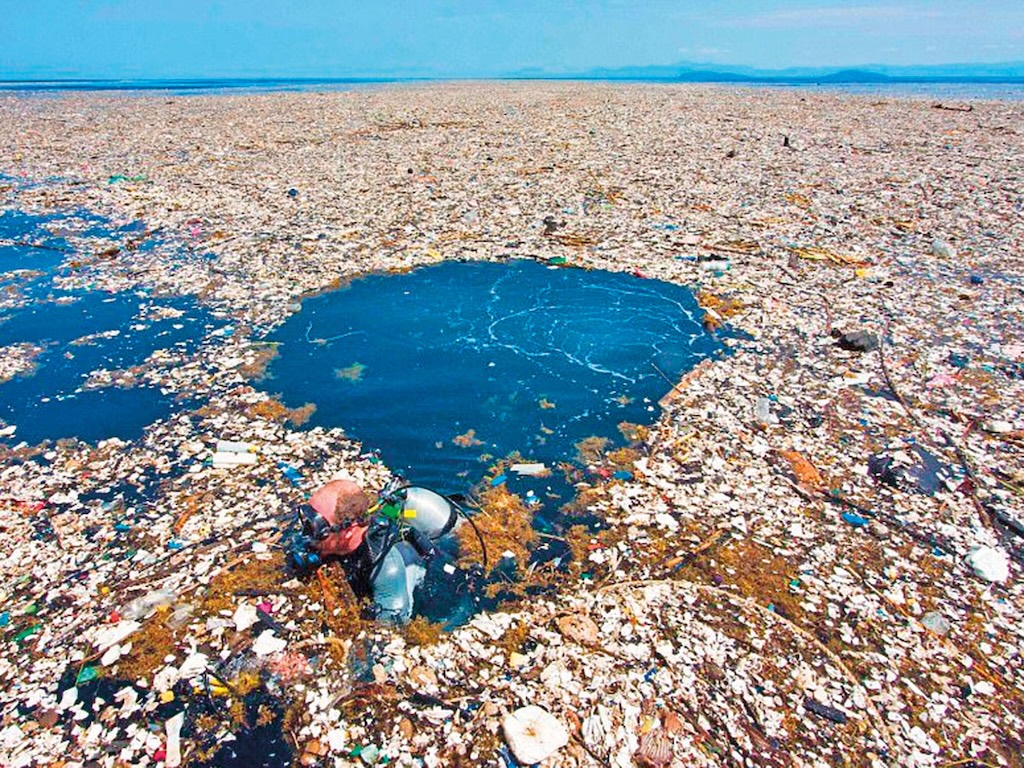
The Pacific Ocean has the most amount of plastic compared to all of the other oceans on earth. This is due to the unique currents and gyres that characterize the Pacific Ocean. Once the plastic bottle joins a circulating system of currents known as the North Pacific Subtropical Gyre, a vast region where debris accumulates because of converging currents more commonly known as the Great Pacific Garbage Patch. This accumulation zone contains over 1.8 trillion pieces of plastic and spans over 620,000 square miles (roughly twice the size of Texas).
The lifespan of a piece of trash within the Great Pacific Garbage Patch can feel almost infinite, circling endlessly in converging currents and breaking free only under the right combination of wind, tide, and season. Winter storms and shifting ocean currents occasionally drive debris eastward toward the Pacific Northwest, washing some pieces of trash ashore. Some pieces touch shore only to be reclaimed by the next tide, and many never beach at all.
By chance, this plastic green tea bottle catches on a length of driftwood and settles into the gravelly beaches of Grays Harbor, half-buried and scoured by sand. After a period of time, an American beachcomber shakes it loose from the sediment and lifts it from the shore, more than 4,750 miles from its place of creation, ending its transoceanic drift not in degradation but in display.
Trashy Connections
By the time ocean trash reaches Grays Harbor, it carries a history. Having crossed languages and coastlines along invisible highways of wind and current while barnacles, algae, and other drifting creatures colonized its surfaces. Sunlight bleaches the plastic and sand buffs the surface, transforming this discarded object from a fleeting convenience into a weathered, enduring artifact. A bottle purchased in Japan can rest on a beach in Washington, connecting distant consumers to Pacific Northwest shores through the shared circulation of a single ocean.
Because these materials persist for generations, their journeys outlast their initial usefulness and turn them into harmful pollutants. The story of ocean plastic is not only about individual choices, but about systems of production, regulation, and responsibility. If trash can travel thousands of miles to reach our shores, and just as easily wash back from our own Pacific Northwest communities into the same ocean, then accountability must move just as freely in every direction. The currents connect us, and so must our commitment to reduce plastic at its source, to demand stronger regulation from those in power, and to invest in restoring the waters we all share. As stewards of this planet, our responsibility extends beyond ourselves to every form of life that depends on healthy oceans, from drifting plankton to seabirds, from current coastal communities to future generations.
Sources:
Plastic pollution. Oceana USA. (2025, December 30). https://usa.oceana.org/our-campaigns/plastic/
NOAA. (2024, July 14). How Big Is the Great Pacific Garbage Patch? Science vs. Myth. National Oceanographic and Atmospheric Association. https://response.restoration.noaa.gov/about/media/how-big-great-pacific-garbage-patch-science-vs-myth.html
Touch whale bones, examine shipwreck artifacts and connect with the coast's living history.

Support our mission, get involved in educational programs, or contribute through donations and volunteering.