Ocean Shores History
Cedar Paddle: CIC Exhibit
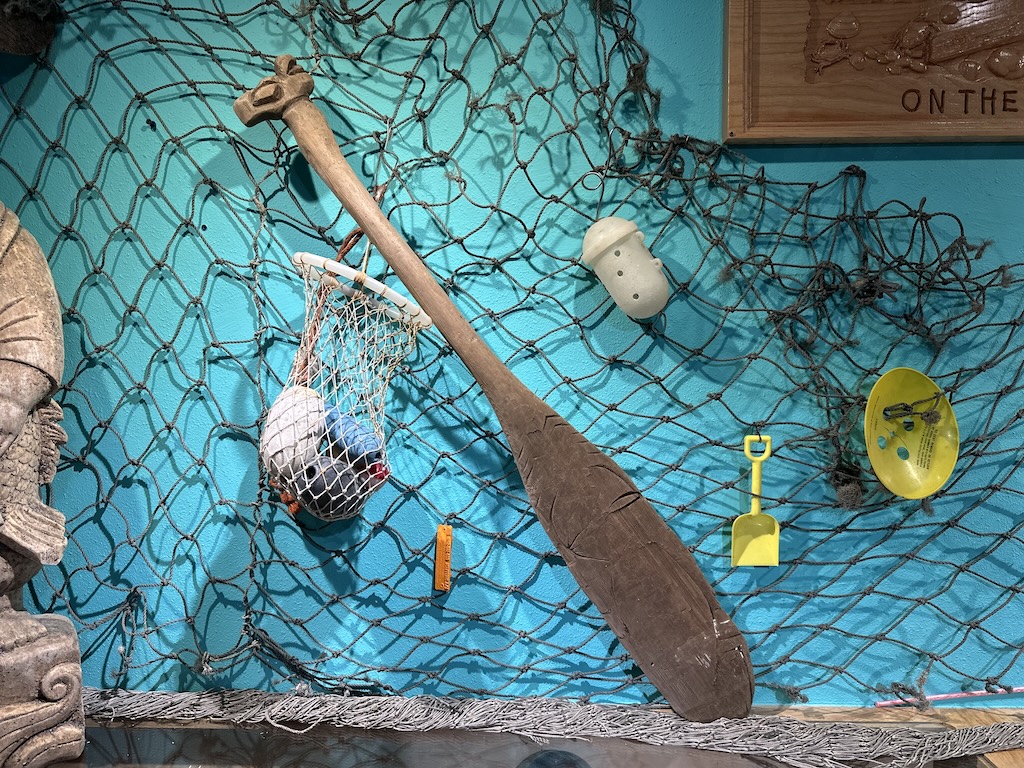
Cedar Paddle
CIC Museum Research Document (Created 3/5/2026) Photograph by Kelly Hewitt. All rights reserved.
Canoe paddles used by the Quinault and other Indigenous peoples of the Pacific Northwest are traditionally carved from a single piece of western red cedar (Thuja plicata), a wood prized for its lightweight strength, buoyancy, and natural resistance to rot. These qualities make it especially suited for prolonged use in lake, river, and maritime travel. Western red cedar has long been central to Indigenous life for numerous communities on the Northwest Coast. Many west coast indigenous communities refer to western red cedar as the “long life maker” because nearly every part of the tree is used to make essential items such as canoes, paddles, shelters, woven baskets, clothing, and ceremonial objects.
For nations such as the Quinault and neighboring Coast Salish peoples, cedar paddles are far more than practical tools. In addition to their role in navigating rivers, estuaries, and ocean waters, paddles function as cultural and spiritual symbols that reflect stewardship, responsibility, and the continuation of ancestral knowledge.
Intertribal Canoe Journeys and Continuing Tradition
Intertribal canoe journeys are a practice that still occur today, having been revived in 1989 when tribal leaders organized the first modern “Paddle to Seattle” as part of Washington State’s centennial celebration. Before this revival, long-distance traditional canoe travel along the Northwest Coast had been largely interrupted by decades of government policies, cultural suppression, loss of traditional skills, and restricted access to old-growth cedar needed to make canoes and paddles. The 1989 event was initiated by Quinault educator and elder Emmett Oliver, who recognized that Indigenous maritime history and canoe traditions had nearly disappeared from daily life and wanted to bring them back as a symbol of resilience, cultural continuity, and Indigenous presence on ancestral waters. Fifteen tribes participated in that first journey, and since then it has grown into an annual tradition with canoe families from many tribes traveling to different host nations each year, stopping at tribal lands along the way to share songs, dances, gifts, and ceremonial practices. For the Quinault Nation and neighboring communities in the Grays Harbor area, these journeys are crucial because they reconnect tribal members with ancestral water routes, revive traditional craftsmanship and cultural teachings, strengthen youth engagement, and reinforce intertribal relationships. Thus, helping sustain cultural identity and social wellbeing across generations.
Paddle Anatomy
A canoe paddle has several distinct parts. The wide, flat end that enters the water is called the blade, which pulls against the water to move the canoe forward. The blade narrows at the shoulder, which connects to the long handle known as the shaft. The point where the blade and shaft meet is called the throat. The top of the paddle is the grip, shaped to fit comfortably in the paddler’s hand.
To paddle properly, one hand holds the grip while the other holds the shaft at about shoulder height. The blade enters the water fully and is pulled straight back alongside the canoe, using the arms and core for steady, even strokes.
Speculating the Origins of the CIC Paddle
The cedar paddle on display in the Beachcomber Room was found washed ashore on the north side of Damon Point in March 2018 by Jody and Bob Lindell. The paddle is heavily worn and appears to have been made for the tourist trade by a local artist. Evidence of worn acrylic paint visible within cracks and crevices suggests the piece is relatively modern. Because the paddle was discovered on the beach, there is no record of the artist or carver who created it.
Faint carved patterns remain visible on the blade, while the handle is roughly shaped into what appears to be an animal head or body. Exposure to saltwater, sand, and weather has significantly worn the surface, softening many of the details despite the paddle’s modern origin.
Although this paddle is modern and its maker is unknown, it reflects artistic traditions rooted in the long history of cedar carving and canoe culture along the Northwest Coast. Understanding that history helps place the object within the broader cultural landscape that inspired its design.
Conclusion
Through cedar and the paddles shaped from it, Quinault people express identity, resilience, and an enduring connection to land and water. Despite the fact that our cedar paddle currently has no known provenance beyond where it was found washed ashore, this piece invites us to critically examine both its origins and the external factors that created it. Whether it was a piece sold in the tourist trade and lost during a storm, lost when a canoe was overturned on a journey, or otherwise separated from its owner, the paddle reminds us that objects can carry layered histories.
Sources
Touch whale bones, examine shipwreck artifacts and connect with the coast's living history.

Support our mission, get involved in educational programs, or contribute through donations and volunteering.