Cedar Totem
CIC Museum Research Document (Created 3/4/2026) Photograph by Kelly Hewitt. All rights reserved.
Totem poles are intricately carved, freestanding wooden pillars traditionally made from western red cedar and yellow cedar. Totem poles are not objects of worship but large monuments that serve a wide variety of purposes, including documenting family lineages, memorializing important community members, marking family homes, asserting territorial rights, and telling stories through iconography. Traditionally, totem poles were erected in a ceremony called a potlatch, commemorating events like marriage, coming of age ceremonies, or death. The figures depicted on totem poles are usually animals, stylized humans, or supernatural figures that represent inherited clan symbols and narratives.
Totem poles are often treated as timeless and interchangeable symbols of the Pacific Northwest, yet their histories are specific, place-based, and culturally distinct. Monumental poles function within clearly defined social systems of lineage, rank, and inherited crest imagery rather than as generalized Native symbols. Although totem poles are now widely synonymous with Pacific Northwest iconography, the pole-carving tradition did not originate in this area. While the Grays Harbor region is home to a rich tapestry of Indigenous communities, including the Quinault, Quileute, Queets, Cowlitz, Chinook, Chehalis, and Hoh peoples; none of these communities were historically associated with the ancestral practice of totem pole carving.
Not From Around Here, But Close By
The Quinault Indian Nation maintains a rich and longstanding artistic heritage that includes elaborately carved cedar canoes and paddles, finely woven baskets, carved house posts, and ceremonial regalia; but were not historically creators of totem poles. Coast Salish carving traditions instead emphasized interior wooden posts and functional ceremonial objects rather than monolithic outdoor totem poles. The tradition of totem pole carving is most closely associated with the Haida Nation, Tlingit, Tsimshian, Kwakwaka'wakw, and Nuu-chah-nulth peoples of the northern Pacific Northwest Coast. The traditional homelands of these communities are modern day northwestern Washington, British Columbia, and Alaska—due north of Grays Harbor.
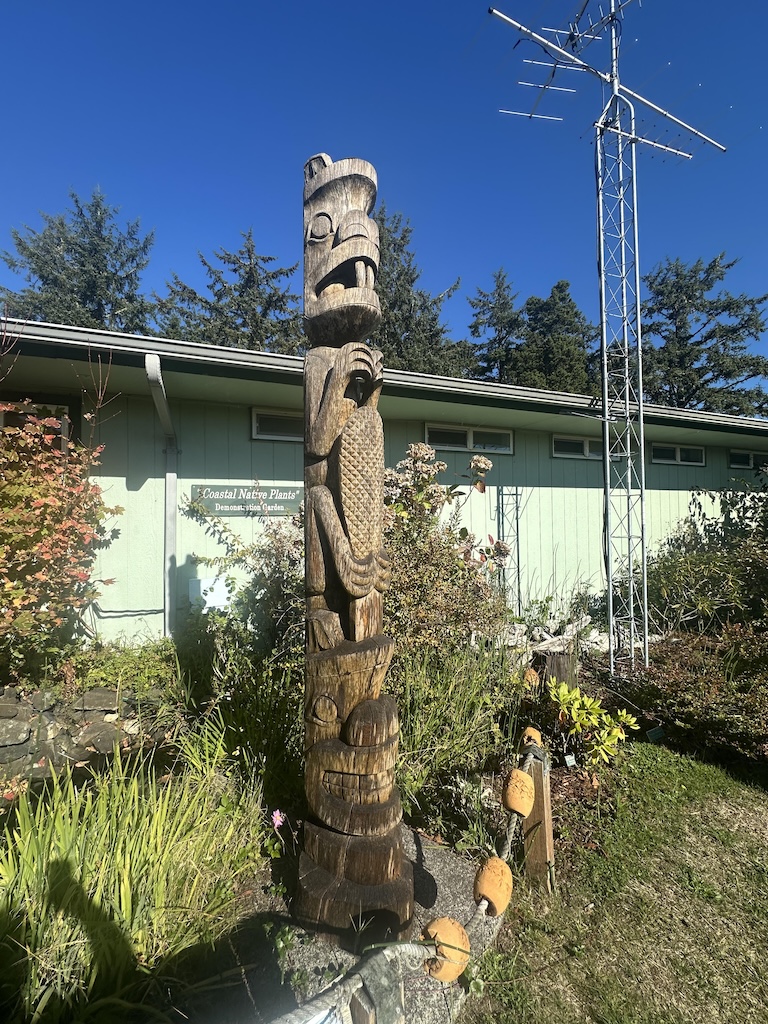
The CIC totem pole is notable for its carver's history: it was donated to the City of Ocean Shores in 1983 by the artist Donald Keys (the date of its donation to the Coastal Interpretive Center is unknown). Though a white man born in Alaska to non-Native parentage, his early life in Grays Harbor County eventually brought him back to Ocean Shores. During his career as an artist he worked solo and in collaboration with tribal artists and tribal nations to paint and carve traditional designs for commissions across the Pacific Northwest (including up the Olympic Peninsula). The CIC's totem pole is based on a Kwakiutl design from northern Vancouver Island.
Public Fascination
As tourism expanded throughout the Pacific Northwest, non-Native audiences increasingly associated monumental poles with a generalized idea of “Northwest Coast Indian” culture. This turned the totem pole into a powerful and marketable symbol. World’s fairs, museums, roadside attractions, and coastal tourist destinations helped popularize the towering cedar pole as an emblem of the region, often without regard for the distinct cultural traditions of individual tribes. In fact, the name “totem pole” is a term created by outsiders and anthropologists, as Indigenous vocabularies vary and often describe these objects in terms grounded in their own languages and worldviews.
Dissecting the Iconography of the CIC Totem
Top Figure:
The topmost figure on this totem pole is a beaver with a scaled tail held between its back paws. The beaver is often used as a symbol representing industriousness, persistence, and the transformative power associated with water and wood, reflecting the animal’s ecological importance.
Bottom Figure:
The bottommost figure on this totem pole is a human face. This face could represent many things: an ancestor, an important figure in a community, or a narrative character connected to the beaver crest.
This totem appears to have been created for decorative purposes and its artist is currently unknown. During the twentieth century, some Quinault artisans began producing totem poles in response to external fascination and commercial demand, which is likely where this totem pole originated from. Without documentation of the carver or commissioning family, the precise meaning of this particular combination cannot be definitively interpreted. However, its imagery draws from a broader northern Northwest Coast visual language rather than local Quinault Nation carving practices.
The Crossroads of Tradition, Tourism, and Public Perception:
Understanding this broader context clarifies the significance of the CIC’s pole. While its beaver and human imagery draw from a northern Northwest Coast visual vocabulary associated with Haida, Tlingit, Tsimshian, Kwakwaka'wakw, and Nuu-chah-nulth traditions, its presence in the Grays Harbor area reflects a twentieth-century moment of cultural circulation and public fascination rather than a continuation of ancestral Quinault carving practices. Recognizing this distinction does not diminish the artistry of the pole. Instead, it nestles the object within a layered history of intercultural exchange, tourism, and the symbolic weight totem poles have come represent in the popular imagination.
By distinguishing between regional traditions and generalized representations, we honor both the northern nations whose ancestors developed the monumental pole-carving tradition and the Coast Salish communities whose artistic expressions followed different but equally sophisticated forms. The CIC’s totem pole invites viewers not only to appreciate its carved forms, but also to reflect critically on how symbols travel, how identities are simplified for public consumption, and how careful interpretation can restore cultural specificity to objects that have long been treated as universal symbols.
Sources
- Hunt, Terena. “Totem Poles.” Native America, Public Broadcasting Service, 2026, www.pbs.org/native-america/totem-poles
- Huang, Alice. “Totem Poles.” Indigenous Foundations, University of British Columbia, 2009, indigenousfoundations.arts.ubc.ca/totem_poles/.
- Jonaitis, Aldona. “The Totem Pole : An Intercultural History.” Internet Archive, Seattle: University of Washington Press; Vancouver: Douglas & MacIntyre, 1 Jan. 2010, archive.org/details/totempoleintercu0000jona/page/n367/mode/2up.
- Unknown. "Totem Pole Donated to OS". North Coast News, Dec, 1983.
- Wright, Robin K. “Totem Poles: Heraldic Columns of the Northwest Coast.” American Indians of the Pacific Northwest Collection, University of Washington, 2002, content.lib.washington.edu/aipnw/frey.html.
- Wright, Robin K. “Totem Poles: Heraldic Columns of the Northwest Coast.” American Indians of the Pacific Northwest Collection, University of Washington, 2002, content.lib.washington.edu/aipnw/frey.html.
- Meyer, Leslie. “Keys, Donald Wells: 1911-1995” HistoryLink.org University of Washington, 2017, https://www.historylink.org/File/20498